
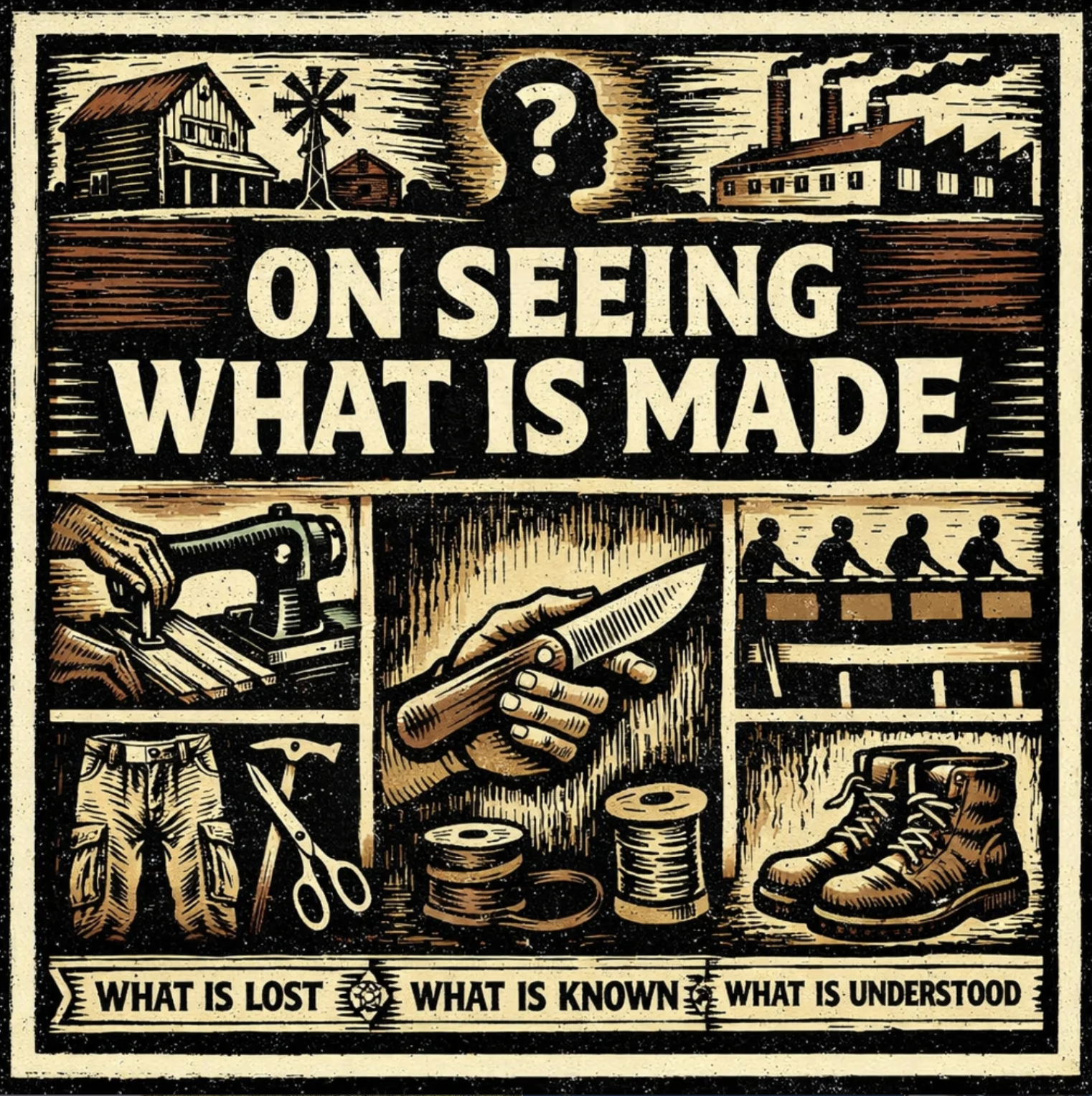
On Seeing What is Made
There is something we are seeing, but do not yet have words for.
We reach for phrases like “handmade”, “artisan”, “cottage industry”, “made in Australia”, as though they describe what is in front of us. They do not. At best, they gesture toward something half-visible. At worst, they obscure it entirely.
“Handmade” does not reliably describe process. The same machines, the same materials, the same sequences of production are often at work. The difference, if there is one, is not easily seen. It sits somewhere else. In intent. In proximity. In relationship.
“Made in Australia”, or the USA, or the UK, does not reliably describe quality. It implies something inherited, something retained. But these places have long since unbound themselves from the material continuity that once gave such claims weight. Skills have moved. Materials have moved. Entire chains of production have dissolved and reformed elsewhere. The label remains, but the substance it points to is no longer guaranteed.
“Cottage industry” belongs to another time entirely. It described necessity, not choice. A distributed mode of production embedded in survival. What we are seeing now is not that.
What we are seeing is something else.
People, often from post-industrial economies, are re-entering production. Not because they must, but because something has been lost. They are learning skills that were removed from the centre of economic life. They are making objects, sometimes for themselves, sometimes for sale. They are attaching stories to these objects, and through those stories, attempting to describe value.
Some of these stories are hollow. Some are not. It is worth distinguishing between them.
Because the object is not the only thing being made.
A knife is not only a knife. A jacket is not only a jacket. A pair of trousers is not only a garment. They carry with them claims. About material. About labour. About identity. About a way of being in the world. The object becomes a vehicle for these claims, whether they are justified or not.
This is where the language begins to fail.
We say “handmade”, when what we mean is that a person is visible in the chain. We say “authentic”, when what we mean is wanting to trust what we cannot see. We say “quality”, when we lack the words to describe quality, and even the critical awareness to inspire the words.
And this lack of language is not incidental. It is produced.
In a society that depends almost entirely on imported, mass-produced goods, the user is separated from the conditions of making. Objects arrive complete, without context, and often carrying assumptions that aren't relevant to the end user. Good that are used, but not understood.
Over time, this produces a particular kind of silence. A loss of experience and awareness that might otherwise correct a design or a product.
From an already limited range, a person wears a garment that restricts movement, that shifts under load, that fails to support the body, that has no lineage or deep identity. They feel discomfort. They may even feel frustration. But without knowing or experiencing anything different, at most they may only say only: “poor quality”. And that's it. We've seen how long a general realisation about synthetics has taken, we haven't even begun to criticise design.
“Poor quality”, is not a description. It is a collapse of many things.
Within that phrase are many possible failures. Of material. Of pattern. Of proportion. Of purpose. Of conception and execution. But without experience of alternatives, without a history of use that allows comparison, without an awareness of materials and process, these distinctions collapse. The feedback loop between use and design breaks down.
Use no longer leads to critique. Critique no longer leads to improvement.
Instead, we have use, dissatisfaction, replacement, but no real correction possible.
Nothing accumulates.
This can be seen most clearly in clothing.

Trousers, for example, have undergone a quiet but profound degeneration. Low rise cuts that restrict movement and humiliate identity. Narrow waistbands that transfer inherent support and comfort to the discomfort of belts. Stretch fibres compensating for a self conscious fashion over function. Pockets unquestionably added, sometimes with no real function at all, but inadvertently encouraging weight into the garment that affects comfort and its primary function!
These features are not accidental. They are logical within a system that prioritises cost, trend, and visual conformity over use. But they are not logical if critical awareness exists.
And yet, for many, they are all that is known.

People no longer know what “high rise” means. They have never experienced a garment that sits and moves with the body rather than against it. They have no reference point from which to critique what is offered to them. They are influenced by fashion and marketing more than heritage and awareness. And from this the cycle continues and intensifies into absurdity.
What is available defines what is imaginable. What is imaginable defines what is acceptable. What is acceptable defines what is produced. What is produced in globalised industry aimed at disabled mass markets, determines what is available..
In this way, global production does not simply respond to culture. It reshapes it. It's a form of “cargo cult”.
This is the condition into which these so-called “handmade” practices emerge.
At their best, they interrupt this cycle.
They reintroduce variation. They reintroduce authorship. They create the possibility that a person might encounter an object that does not conform to the narrow band of what has been normalised. In that encounter, something can happen. A recognition. A discomfort. A sense that things could be otherwise.
This is where value begins to take on a different meaning.

Not in the fact that something was made by hand. Not in the location stamped on its label. But in its capacity to restore a recognition and propose a relationship. Between user and object. Between body and material. Between experience and understanding.
A well-made object, in this sense, is not defined by its method of production, but by its legibility. It can be read. It can be understood through use. It teaches something about itself, and in doing so, teaches something about the world.
This is not nostalgia, or rather, it should not be.
There is a temptation to frame all of this as a return. To older ways. Simpler times. But this is often a selective reconstruction, one that omits as much as it reveals. The past was not inherently more virtuous, nor more free.
What is valuable is not the past itself, but the knowledge that has been lost, and the possibility of recovering it in a new context.
The danger lies in mistaking the symbols for the substance. In believing that “handmade” is enough. That “local” is enough. That material is enough. That a story, well told, is sufficient to carry meaning.
It is not.
If the underlying design remains unexamined, if the object does not meaningfully engage with use, with body, with material, then the narrative is empty. It becomes another layer of abstraction, another way of avoiding the thing itself.

What is required is something more difficult.
A rebuilding of material literacy. A willingness to look closely at how things are made, how they function, how they fail. A capacity to describe these things with precision. To move beyond “quality” as a catch-all, and toward a language grounded in experience.
And alongside this, a form of production that is not primarily concerned with scale, but with relationship. Where the maker is not hidden, but neither are they the product. Where the object stands on its own terms, but remains connected to the conditions of its making, and the meaning of its existence.
This is not a movement that can be named easily. It is not a cottage industry. It is not simply craft. It is not an escape from industrialism, nor a rejection of it. It is a response.
To disconnection. To loss of knowledge. To the narrowing of what is considered normal, acceptable, possible.
It is an attempt, however incomplete, to re-enter the chain of production. To become, again, participants rather than passive recipients. To begin to see the world responding to our ideas.
Whether it succeeds depends not on the words used to describe it, but on the depth of understanding it is able to generate.
Because in the end, the question is not whether something is handmade.
The question is whether we can see, feel, and understand the world it comes from.
And whether, through that understanding, we can begin to shape it differently.